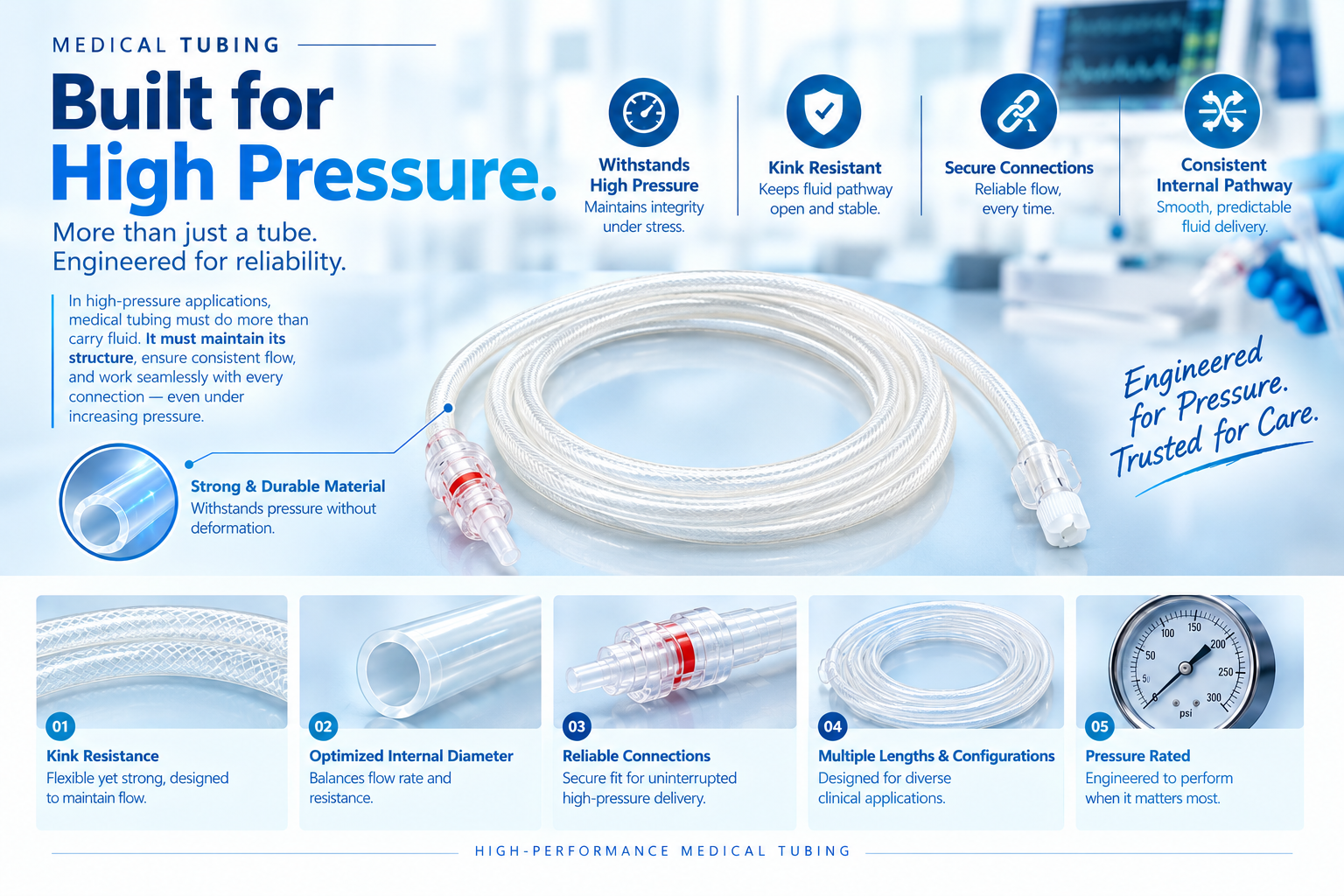
Built for Pressure: What Really Matters in Medical Tubing
Medical tubing can look deceptively simple. It connects one part of a system to another, carries fluid through a defined pathway, and often works quietly in the background of a procedure. But the moment pressure rises, that simple-looking tube has a much more demanding job to do.
During applications that involve pressurized fluid delivery, tubing must continue to provide a reliable pathway while handling the forces created within the system. Its material, construction, internal pathway, connections, and resistance to deformation can all influence how consistently it performs. Understanding what happens inside medical tubing when pressure increases helps explain why something as straightforward as a tube requires careful engineering.
Pressure Changes the Demands on the Tubing
When fluid moves through medical tubing, it encounters resistance. As the pressure required to move that fluid increases, the tubing and its connections are exposed to greater mechanical demands. This matters particularly in applications where fluid must be delivered rapidly or under controlled high-pressure conditions. The tubing needs to maintain its intended structure throughout the process. Excessive deformation, kinking, or an unreliable connection could interfere with the fluid pathway and disrupt the procedure.
In other words, the challenge is not simply getting fluid from one end to the other. It is doing so predictably while the system is under pressure.
What Is Happening Inside the Tube?
Imagine fluid entering a length of tubing under pressure. The fluid pushes forward, but it also applies force against the internal walls of the tube. As pressure rises, those walls need to tolerate increasing stress while maintaining the pathway through which the fluid is travelling. This is where tubing construction becomes important. A well-engineered tube must balance several requirements. It needs sufficient structural integrity for its intended application while remaining practical for clinicians to position and handle.
The internal pathway also needs to remain consistent. If the tube bends excessively or develops a kink, resistance to fluid movement can increase and interfere with predictable delivery. What looks like a simple connection from the outside is therefore a carefully managed interaction between fluid, pressure, material, and device design.
Why Kink Resistance Matters
Medical tubing rarely remains perfectly straight during actual use. It may need to move around equipment, across a procedure area, or between different components of a fluid delivery system. These practical conditions make resistance to kinking an important design consideration. A kink narrows the pathway available for fluid to travel through. That narrowing can increase resistance and affect flow through the system.
Under pressure, maintaining an open and stable pathway becomes particularly important. This is why tubing design needs to consider flexibility and structural stability together. Tubing should be manageable enough for practical clinical use without easily losing the integrity of its fluid pathway when positioned.
The Connection Points Carry Responsibility Too
The tube itself is only one part of the system. At either end are connection points that link the tubing with other components. When pressure rises inside the system, these connections also need to remain reliable. A secure connection helps maintain continuity throughout the fluid pathway. This is particularly important because a high-pressure system depends on its components working together rather than independently.
A tube designed to withstand its intended pressure would offer limited value if the connection between components could not perform under the same operating conditions. It is another example of how small details become important when the entire system is considered.
Why Tubing Length and Internal Pathway Matter
Medical tubing is used across different clinical setups, which means the distance between connected components may vary. Tubing length therefore has a practical role in how a system is arranged. At the same time, the fluid still needs to travel through the entire internal pathway. As with other aspects of infusion and fluid delivery, resistance within a pathway can influence flow and pressure dynamics. The reference article, for example, highlights how internal diameter and resistance affect fluid movement through IV devices. For medical tubing, this reinforces an important engineering principle: dimensions, material properties, positioning, and intended pressure conditions need to be considered together rather than as isolated specifications.
Pressure Rating Is More Than a Number
When looking at high-pressure tubing, it is easy to focus on a single specification: the pressure rating. But that number represents a much broader engineering requirement. Tubing intended for pressurized applications needs to be designed so that its material, structure, connections, and overall construction can support the conditions for which it is intended. That is why pressure capability should not be viewed simply as a number printed on a product specification. It reflects the need for the entire fluid pathway to perform reliably when mechanical demands increase.
Engineering for Real Clinical Environments
Medical devices do not operate in ideal laboratory diagrams. They are handled, connected, positioned, moved, and used alongside other equipment in real clinical environments. For Medivation Bio, this makes the engineering behind medical tubing an important part of supporting practical fluid delivery applications. Attention to structural integrity, kink resistance, dependable connections, and consistent fluid pathways helps address the demands placed on tubing during use. The objective is not to make tubing unnecessarily complicated. It is to engineer a seemingly simple device carefully enough that it can perform its role without becoming the focus of the procedure.
Conclusion
Medical tubing may be one of the quieter components of a fluid delivery system, but increasing pressure reveals just how much is expected from it. Inside the tube, fluid is moving against resistance and applying force to the tubing walls. Around it, the material needs to maintain its structure, bends need to remain manageable, and connection points need to stay dependable. Each of these details may appear small when considered individually. Together, they determine whether medical tubing can continue doing its most basic and most important job: providing a reliable pathway for fluid when the pressure goes up. Sometimes, the devices that look the simplest are the ones where careful engineering matters most.
