Why Does Medicine Need So Many Different Types of Catheters
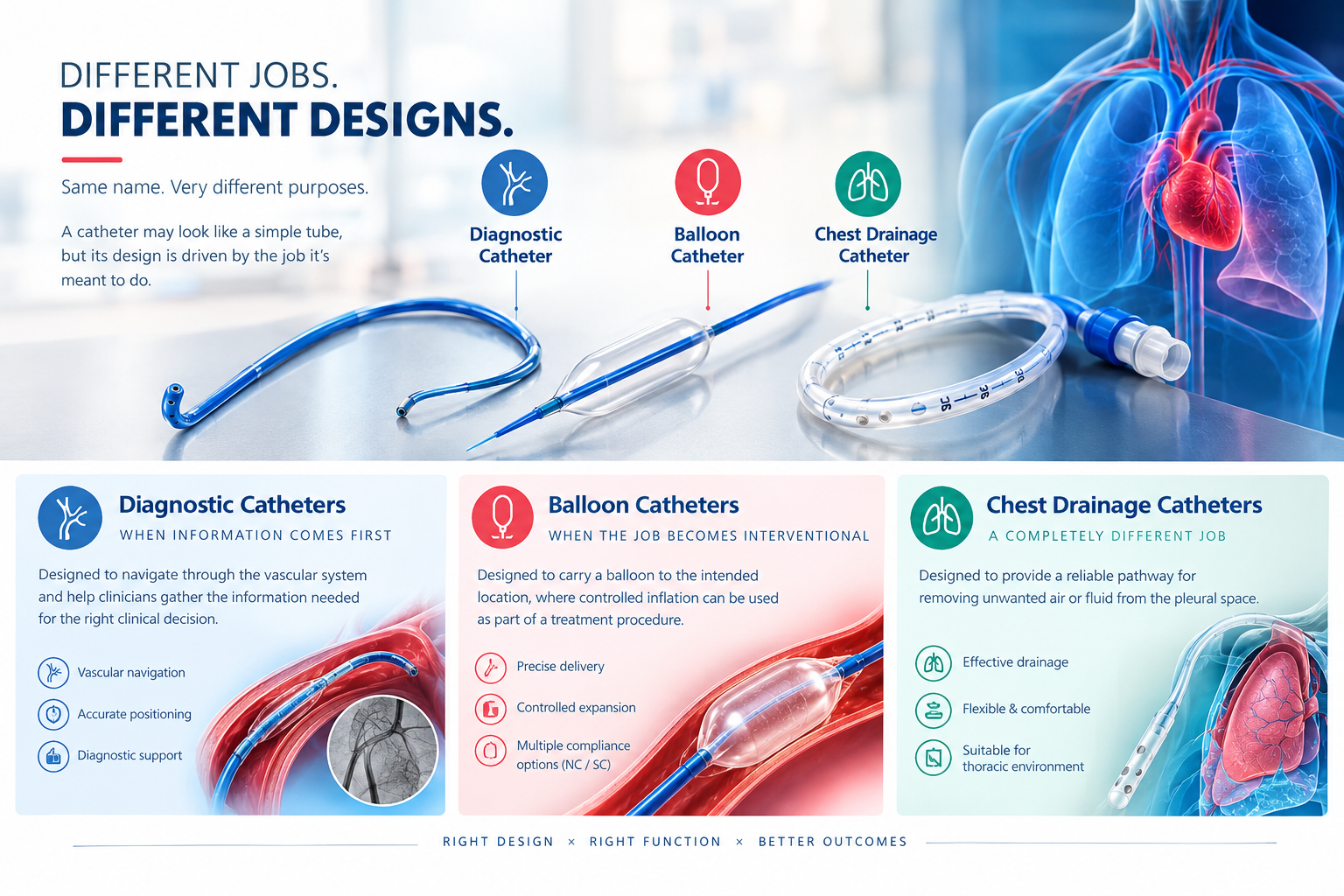
At first glance, the word “catheter” sounds like it describes one type of medical device. A thin, flexible tube designed to enter the body and perform a specific task. Look a little closer, however, and the picture becomes much more interesting. A catheter used to help visualize blood vessels has a very different job from one carrying a balloon to an intended location. And neither is designed for the same purpose as a catheter used to drain unwanted air or fluid from the chest.
So, why does medicine need so many different types of catheters? Because the word may describe a family of devices, but the job each catheter is expected to perform determines how it needs to be designed.
It Starts With the Clinical Purpose
There is no single catheter design that can meet every clinical requirement. Some procedures require clinicians to navigate through blood vessels and gather diagnostic information. Others involve delivering an interventional device to a specific location. In another clinical situation, the objective may be to create a pathway through which accumulated fluid or air can be drained. Each of these situations places different demands on the catheter. Its length, diameter, flexibility, shape, tip characteristics and overall construction need to reflect where it will be used and what it is expected to accomplish. That is why understanding catheters becomes much easier when we stop looking at them simply as tubes and start looking at the jobs they are designed to perform.
Diagnostic Catheters: When Information Comes First
Before an intervention can be planned, clinicians often need a clear understanding of what is happening inside the cardiovascular system. This is where diagnostic catheters have an important role. Designed to navigate through the vascular system, these catheters can support diagnostic procedures in which clinicians need to reach particular anatomical locations and obtain information necessary for clinical decision-making.
Their shape is not simply a design choice. Different anatomical pathways and procedural requirements can call for different catheter configurations. This makes navigation, control and appropriate catheter selection important parts of the diagnostic process. In simple terms, the diagnostic catheter helps answer an essential question before treatment moves forward: what exactly are we dealing with.
Balloon Catheters: When the Job Becomes Interventional
The purpose changes when we move from diagnosis to intervention. Balloon catheters are designed to carry a balloon to the intended treatment area, where controlled inflation can be used as part of an interventional procedure. But even within the category of balloon catheters, one design does not necessarily suit every procedural requirement.
For example, non-compliant (NC) and semi-compliant (SC) balloons behave differently as inflation pressure increases. This difference in balloon compliance gives clinicians options based on the procedural objective. A semi-compliant balloon can exhibit greater change in diameter as pressure increases, while a non-compliant balloon is designed to provide more controlled expansion across its specified working range. The distinction may sound highly technical, but it illustrates something important: even two devices that are both called “balloon catheters” can be engineered differently because they are expected to behave differently during use.
Chest Drainage Catheters: A Completely Different Job
Now move away from the vascular system and consider a different clinical challenge. When unwanted air or fluid accumulates in the pleural space, the objective is no longer vascular diagnosis or balloon-based intervention. The clinical need is drainage.
A chest drainage catheter is designed to provide a pathway through which this air or fluid can be removed as part of appropriate clinical management. That completely different purpose changes what matters in the device. Rather than carrying an interventional balloon or supporting cardiovascular diagnosis, the catheter needs to function as a dependable drainage pathway while being suitable for its intended anatomical environment. It is still called a catheter, but its role demonstrates just how broad that term really is.
Why Catheter Design Changes With the Job
Put these devices next to one another and a common principle becomes clear: form follows clinical function. A diagnostic catheter needs characteristics that support vascular navigation and the intended diagnostic procedure. A balloon catheter needs to combine navigation and deliverability with predictable balloon behaviour.
A chest drainage catheter has to provide an effective pathway for drainage. This is why features such as flexibility, dimensions, material, configuration and structural characteristics cannot be considered in isolation. They have to make sense in relation to what the catheter is actually being asked to do. The same principle can be seen across medical device engineering more broadly. As highlighted in IV cannula design, characteristics such as flexibility, structural integrity and reliable flow pathways are considered alongside the practical demands of clinical use.
One Product Family, Many Clinical Needs
For healthcare professionals, having different catheter options is not about adding unnecessary complexity. It reflects the variety of clinical situations they encounter. Medivation Bio's catheter portfolio follows this principle by addressing different requirements across diagnostic, interventional and drainage applications. Diagnostic catheters support cardiovascular diagnostic procedures, while balloon catheter solutions such as Mediteire NC and Mediteire SC address different interventional requirements through their respective balloon characteristics. Chest drainage catheters extend the portfolio into another area altogether, where creating a dependable drainage pathway becomes the priority.
Although these products belong to the broader catheter family, each begins with a different question: Where does the device need to go? What does it need to do when it gets there? And how should it behave while doing it? Those questions ultimately shape the device.
Engineering Around the Procedure, Not Just the Product
Good catheter engineering is not simply about creating a thinner tube, a different curve or another balloon. It begins with understanding the procedure. How will the clinician navigate the device? What anatomical environment will it encounter? Does the catheter need to deliver something, support diagnosis, expand at a target location or provide drainage? What characteristics will help it perform that particular role consistently?
Looking at catheter development this way shifts the conversation from individual specifications to practical clinical requirements. For Medivation Bio, this means developing catheter solutions around distinct applications rather than treating every catheter as a variation of the same device. Because in healthcare, a product only makes sense when its design makes sense for the job it needs to perform.
Conclusion
Medicine needs many different types of catheters for a simple reason: there are many different jobs for them to do. A diagnostic catheter helps clinicians navigate and gather information. A balloon catheter takes an interventional role, with its balloon characteristics designed around specific procedural requirements. A chest drainage catheter provides a pathway for an entirely different purpose, the removal of unwanted air or fluid. They may share a name, but they do not share a single function. And that is what makes catheter design so interesting. The differences are not there simply to create more product choices. They exist because anatomy, procedures and clinical objectives are different. The word “catheter” may describe the family. But ultimately, the job is what shapes the device.
